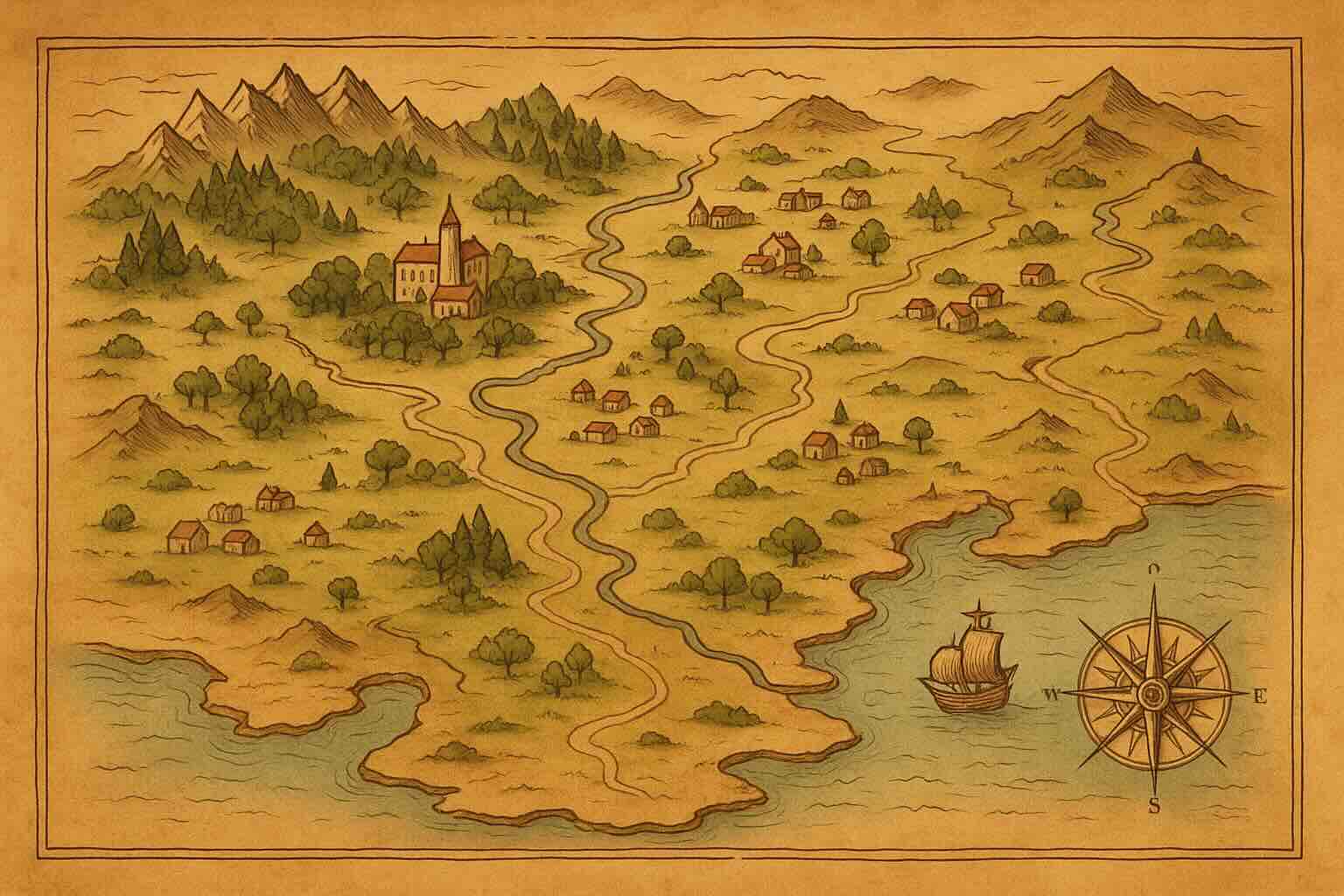
Last week we explored how fictional diaries in stories can inspire your own journaling practice. Diaries in fantasy often hold secrets, reveal hidden truths, or transform the characters who write in them. They remind us that the act of putting words on paper has power in our lives too. This week I want to extend that idea by looking at another object that shows up again and again in fantasy fiction: the map.
There is something magical about opening a book and seeing a map on the first pages. A map signals that you are entering new territory. It promises adventure while offering just enough guidance to keep you oriented. In fiction, maps are more than charts of geography. They are storytelling tools, symbolic guides, and sometimes enchanted artifacts in their own right. They also give us a way to think about our own lives. If journals are about recording where you have been, maps are about imagining where you might go.
J. R. R. Tolkien’s hand-drawn map of Middle-earth is perhaps the most famous example. When you unfold the pages of The Lord of the Rings, you see mountains, rivers, forests, and distant kingdoms. The Shire looks small and cozy, while Mordor sits far away yet ominously present. Before Frodo even leaves home, the reader knows the scope of the journey. That map does not just show landforms. It carries story and meaning. It tells you that danger is vast but that small places matter too.
In contrast, the Marauder’s Map in Harry Potter and the Prisoner of Azkaban is not static at all. It reveals the living heartbeat of Hogwarts, tracking people in real time. For Harry and his friends, the map is both mischief and survival. It shows secret passages, moving footprints, and the unseen layers of the castle. This map is more than paper. It is empowerment. It gives knowledge that can change choices. It reminds us that sometimes seeing the bigger picture is enough to alter how you move within a space.
Contemporary fantasy continues to use maps in inventive ways. Leigh Bardugo’s Grishaverse includes detailed maps of Ravka, Fjerda, and Shu Han. Borders are not just lines on parchment but expressions of politics, culture, and conflict. The maps help readers grasp how divided worlds shape divided characters. Philip Pullman’s His Dark Materials shifts the idea even further. Instead of one map, he gives us tools like the alethiometer and the subtle knife, which act as metaphysical maps to other worlds. These guides are not about terrain but about navigating truth and reality itself.
Maps in fiction work because they engage both the eye and the imagination. They show us the scale of the world and hint at what lies beyond the edge. They orient us but also spark curiosity. A blank space on a fantasy map is as thrilling as a blank page in a journal. Both suggest possibility. Both dare us to fill them in.
If last week’s lesson from diaries was about reflection, this week’s lesson from maps is about direction. Journaling asks, “Who am I right now, and what have I learned?” Mapping asks, “Where am I headed, and what paths might I take?” Together they form a cycle. One captures your past and present, the other gestures toward your future.
So how do you use this in your own practice? One way is to literally draw a map in your journal. It does not have to be cartographically accurate. Imagine your life as a landscape. What mountains stand for challenges you have climbed? Where are the valleys of rest and recovery? What rivers keep showing up as sources of energy or inspiration? Place yourself on that map and ask: where is the road leading next?
Another exercise is to create a map of your inner world. Writers often draw maps of kingdoms that do not exist, but you can do the same for your emotions, dreams, or goals. Maybe the land of Creativity borders the swamp of Doubt. Maybe there is a small hidden island called Hope that you want to visit more often. Giving your inner life a geography makes it easier to see connections and patterns.
You can also use maps as a way to visualize choices. Tolkien’s map shows many roads, rivers, and mountains. The Marauder’s Map reveals secret corridors. Your own map can lay out alternate routes for decisions you face. Draw paths branching in different directions and imagine what lies at the end of each. Sometimes the act of putting it on paper makes the decision clearer.
What makes fictional maps so powerful is that they are never just about land. They are about meaning, history, and potential. Your personal maps can work the same way. They can remind you that life is not one straight road but a landscape of possibility. You may not know every detail, but sketching it out helps you move with more awareness and purpose.
In my last blog article, I suggested that journaling is a kind of magic because it captures your story in real time. Maps add a complementary kind of magic. They give you perspective, orientation, and vision. Put together, the diary and the map are the perfect pair: one records where you have been, the other inspires where you are going. And like the best fantasy novels, your own life deserves both.
Further Reading
If you want to explore more fictional maps that have captured readers’ imaginations, here are some classics worth studying:
- The Lord of the Rings by J. R. R. Tolkien — iconic maps of Middle-earth that inspired generations of fantasy cartography.
- A Song of Ice and Fire by George R. R. Martin — sprawling maps of Westeros and Essos that highlight political intrigue and shifting borders.
- The Inheritance Cycle by Christopher Paolini — maps of Alagaësia that mirror the coming-of-age journey of its young hero.
- The Wheel of Time by Robert Jordan — intricate maps that ground the epic scale of the series in a richly detailed geography.
- Earthsea by Ursula K. Le Guin — island maps that emphasize the sea as both barrier and connection, shaping the story’s themes of balance and power.