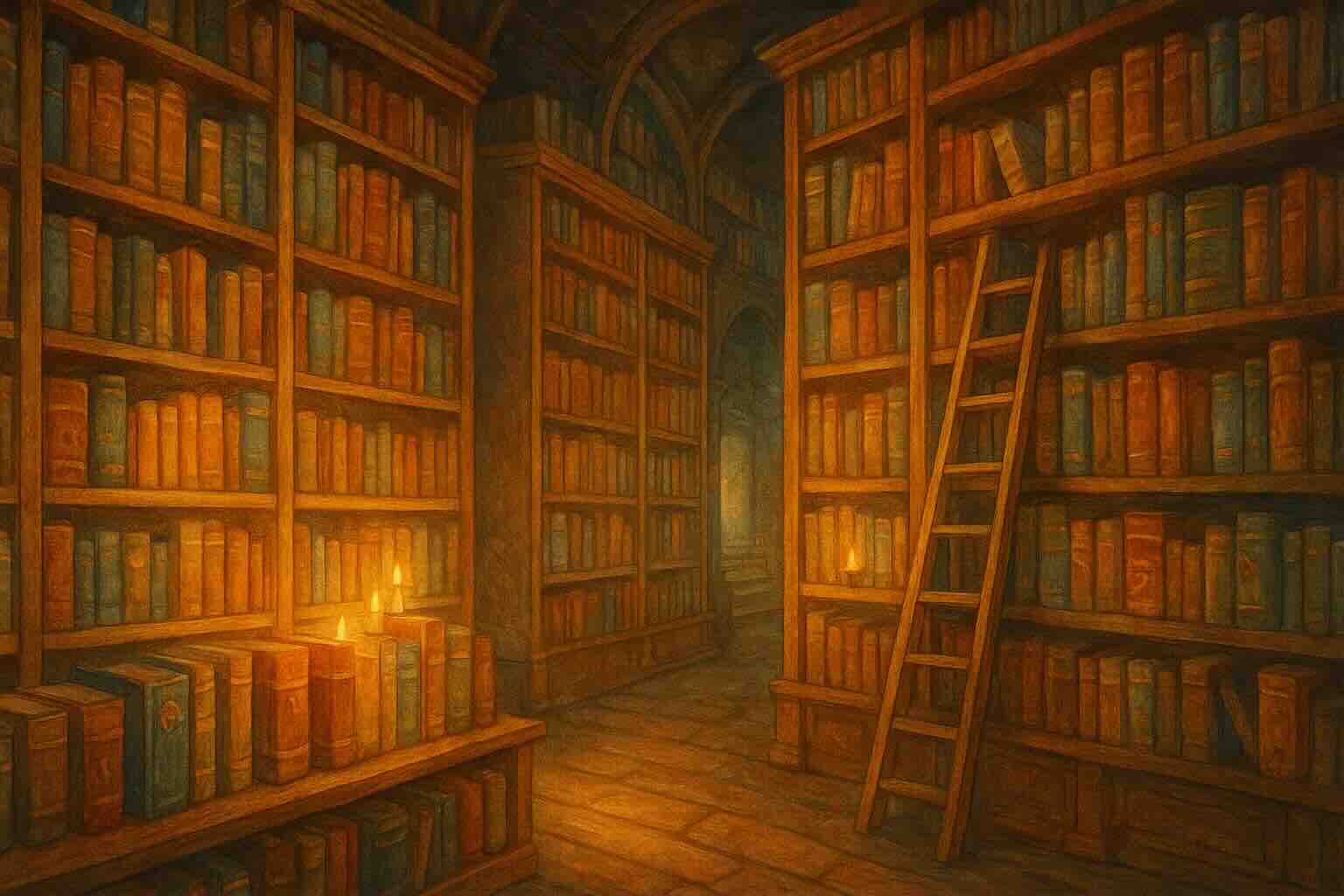
Over the past few weeks (I skipped last week to feature a special Halloween featured blog last week) we looked at two beloved fantasy objects that hold surprising lessons for real life. First came fictional diaries, which can inspire your own journaling practice. Then we turned to fantasy maps as guides for imagining where your journey might lead. This week we enter the hush of a new realm: the magical library.
Libraries in fiction are irresistible. They are places of infinite knowledge, hidden power, and delicious secrets. Think of the Restricted Section at Hogwarts in Harry Potter, where dusty tomes whisper forbidden spells. Or the Great Library of Unseen University in Terry Pratchett’s Discworld, where some books are so enchanted they need chains to stop them wandering. Erin Morgenstern’s The Starless Sea offers a dreamlike underground archive that turns stories into doorways. Each of these collections feels alive, like more than mere stacks of paper. They are characters in their own right.
Why do magical libraries resonate so deeply? Part of the answer is that we already treat books as enchanted objects. Anyone who has gotten lost in a story knows words can transport you across worlds. Fictional libraries exaggerate that truth. They take the awe we feel in a real library and make it literal magic. They remind us that gathering knowledge is not just academic. It is transformative.
Magical libraries also test characters. In Harry Potter and the Sorcerer’s Stone, Harry sneaks into the Restricted Section and nearly gets caught. The lesson is clear. Some knowledge is powerful and dangerous, and reaching for it requires courage. In Lev Grossman’s The Magicians, the library at Brakebills shapes the education of budding magicians. Access is tied to responsibility. Knowledge has a cost.
There is an emotional hook too. A magical library embodies abundance. It says: here is more than you can ever consume, but you are welcome to try. The stacks stretch endlessly. There is always another secret to uncover, another clue that might change everything. That promise keeps readers hooked, but it also mirrors how we experience real life. Our own shelves and notebooks can feel bottomless. That is not overwhelming if you treat it as a gift rather than a burden.
So what can you borrow from fictional archives for your reading and writing life?
First, curate with intention. In The Starless Sea, the underground library reflects the longings of the people who wander its halls. In the same way, your personal library can become a mirror of your interests and identity. The books you keep close are not random. They are clues to who you are and who you want to be. Make a short shelf of “North Star” titles that always pull you back to purpose.
Second, treat reading as conversation, not a checklist. Magical libraries buzz with interaction. Imagine your shelves as an ecosystem where books talk to one another. A memoir next to a fantasy novel might spark an idea you would never find if you read them in isolation. Keep a reading journal beside you and capture cross-talk: pair a quote from Discworld with a line from a craft book, or connect something in The Magicians to an idea in your current work-in-progress. Over time that notebook becomes your personal grimoire.
Third, create your own restricted section. Not every page is for public view. Some entries are raw or half-formed and need time to ripen. Make a “restricted shelf” in your notes where you stash private reflections, risky ideas, and spells you are not ready to cast. Think of it like the Hogwarts Restricted Section or the chained tomes of Unseen University. The privacy gives the work room to grow.
Fourth, wander on purpose. Fictional libraries rarely lay everything out neatly. Corridors twist, ladders stretch upward, hidden doors appear. You can mimic that sense of discovery by letting curiosity lead. Follow a footnote. Open a book at random and write for ten minutes from the first striking sentence. Start a “rabbit-hole log” that tracks the delightful detours that feed your creativity.
Fifth, archive what matters. Magical libraries guard more than facts. They collect maps, letters, artifacts, memories. Build a small archive for your creative life. Save three things each week that moved you: a paragraph, a lyric, a line you wrote at 2 a.m. Tag them by theme in your notes app or binder. This becomes your portable Starless Sea, ready whenever you need inspiration.
In this series a pattern is emerging. Diaries teach reflection. Maps teach direction. Libraries teach curation and stewardship. Put them together and you have a toolkit for growth: write your story as it unfolds, chart possible paths, and gather the wisdom you need along the way. Like your favorite heroes, you are already inside the quest. The library is open, the ladder is steady, and the next book might be the key you were looking for.
Further Reading
- Harry Potter series — for the atmosphere and ethics of the Hogwarts Restricted Section.
- The Magicians by Lev Grossman — Brakebills’ library as a training ground with consequences.
- Discworld by Terry Pratchett — the Great Library of Unseen University, complete with wandering volumes and a very determined Librarian.
- The Starless Sea by Erin Morgenstern — a subterranean archive that turns stories into portals.
- Your world: the Night Library in Shadow Wolf on mskaminsky.com — a living archive that shapes Moonshifter Academy’s fate.