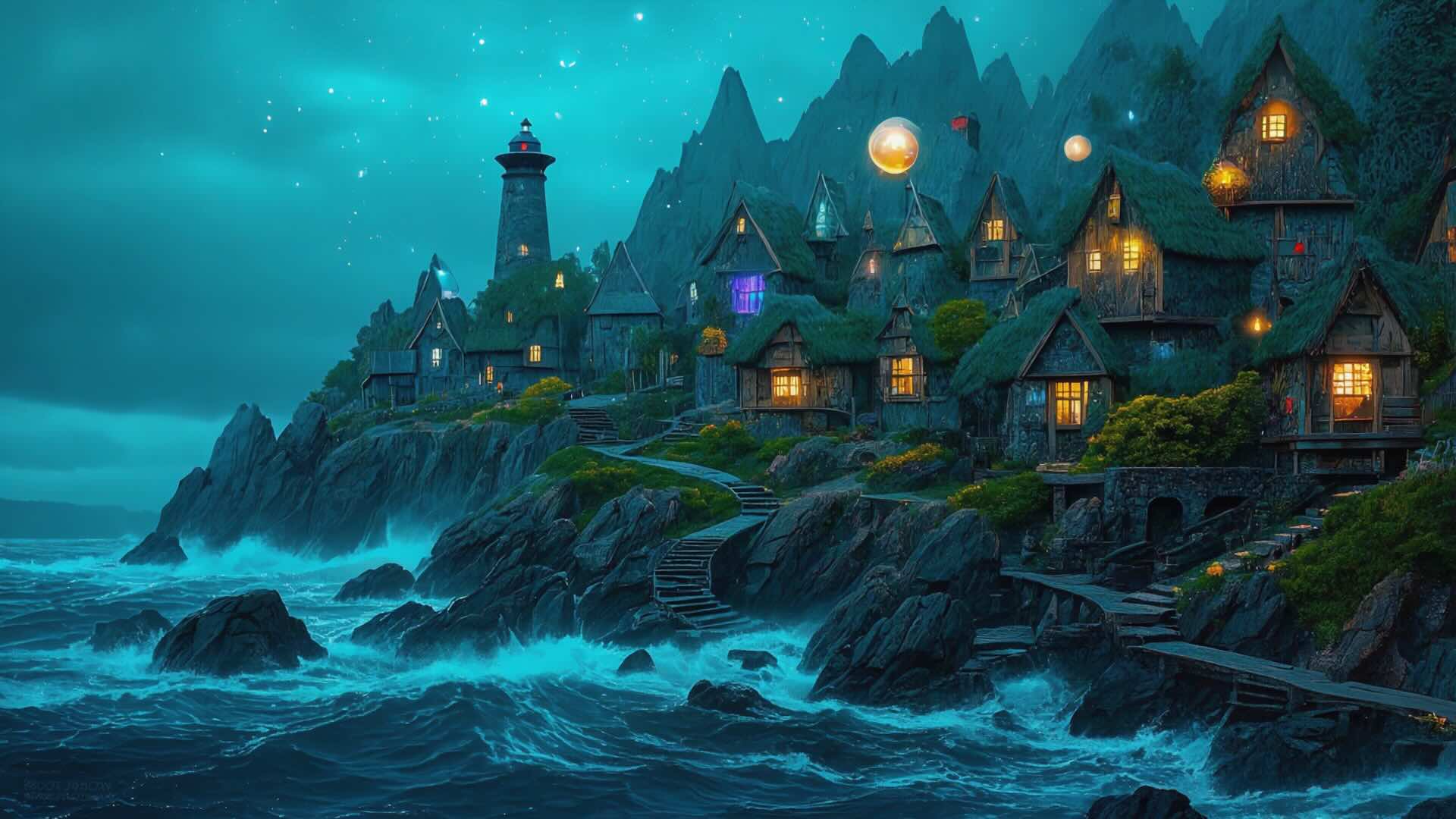
So here’s what’s been circling in my head lately: coastal cities in fantasy.
Not just pirate hideouts or storm-battered ports, but fully realized civilizations shaped by the sea. I’m talking floating academies, cities built into cliffsides with rope bridges and glimmering towers, underwater temples that only surface during certain moons. I keep imagining walkways made of woven kelp, sea glass lanterns that glow with tide-magic, and communities that don’t fear the ocean but live as part of it.
It’s definitely not the kind of story I usually write.
My most recent work, like Moon Shifter Academy, leans into urban fantasy. The kind where magic hides inside the real world. There are cell phones, cafeteria trays, and hallway whispers plus danger, secrets, and transformation. That’s the rhythm I know.
But this idea? It’s pulling me somewhere else entirely.
It feels like it belongs in a high fantasy world. One with no modern infrastructure. No cars. No cities as we know them. Just magic, mythology, and survival shaped by nature.
And honestly, I’m wondering if I can pull it off.
What Would an Ocean City Look Like?
I’ve been researching real-world floating communities and storm-facing cultures, and it’s amazing how much inspiration is already out there.
- The Bajau people of Southeast Asia live much of their lives on water, and some of them can hold their breath for over five minutes while diving.
- Giethoorn, Netherlands is a village built entirely around canals, where people travel by boat instead of roads.
- The Uros people of Lake Titicaca live on floating islands made from woven reeds. Their homes, boats, and even schools are constructed from what grows in the water.
Now imagine weaving that kind of architecture into a magical world. Where storms are living spirits. Where schools are shaped by tides. Where the economy is based on sea creatures and sunken relics.
It’s not just a change in setting. It’s a change in how the characters move, eat, dress, speak, and survive.
From Urban to High Fantasy
Making this shift feels a little like switching genres midstream. Urban fantasy is grounded. It borrows from the familiar. High fantasy, especially the kind I’m daydreaming about, means building everything from scratch. Geography. Religion. Culture. Language. Magic systems that aren’t based on ancient bloodlines but on salt, tide, and breath.
Writers like N.K. Jemisin do this beautifully. Her worlds feel ancient and enormous, but also immediate and emotional. Robin Hobb creates seafaring cultures with deep, messy histories. Even Tamsyn Muir, though not writing high fantasy in the traditional sense, builds systems that feel wildly original and completely immersive.
Can I make that leap? I honestly don’t know yet. But the thought of trying is weirdly energizing. This summer has certainly been an exploration.
What I’d Love to Know
Do you like high fantasy that leans into nature and ritual? Do you prefer fantasy grounded in real-world tech and city vibes? If you’ve read something that blends both like magic tech on floating cities or fantasy worlds with real architecture problems I want to hear about it.
Also, if I wrote a sea-bound story like this, would you read it? Be honest. I can take it.
For now, I’ll keep sketching out waterlogged maps and scribbling ideas about wind-born magic. The sea has a pull, and I’m letting myself drift.
Let’s see where it goes.