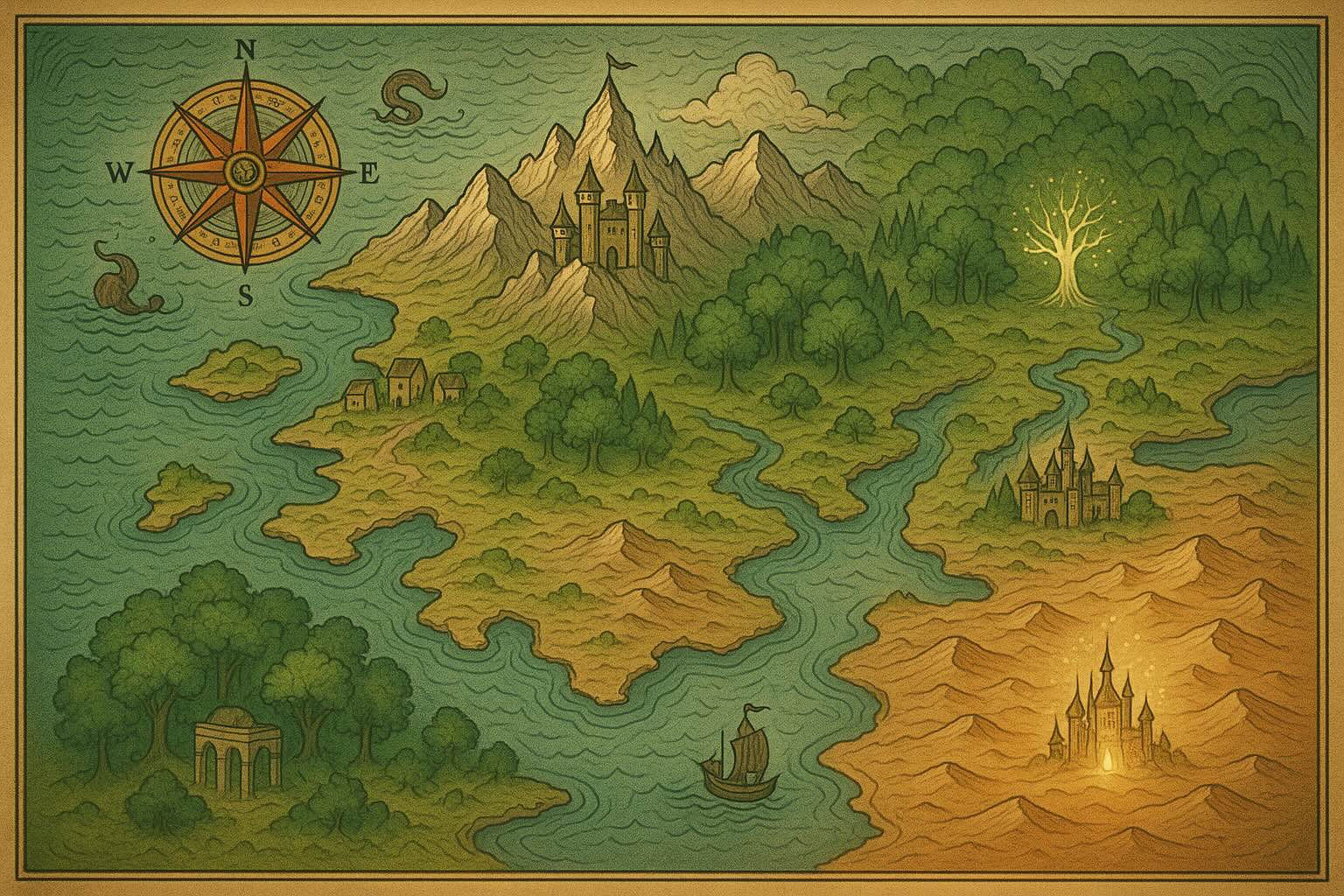
There’s something magical about a good map. Even before we meet the hero or learn what terrible thing is about to befall the kingdom, a map gives us a vibe. It whispers, this world is real. It has history. And you’re invited. That little compass rose in the corner? That’s your ticket to adventure.
In fantasy, geography isn’t just background scenery. It’s story fuel. A desert isn’t just sand and sun. It’s a place of trial, where characters are pushed to the edge. A forest can be a sanctuary or a trap, depending on who’s wandering through. And cities? Cities are where secrets live. They’re full of shifting alliances, hidden doors, strange magic, and the occasional morally questionable prince.
Think about Arrakis in Dune. That’s not just a hot, miserable planet. It’s a crucible for testing power and belief. Or take the Blight in The Wheel of Time, where the land itself turns hostile. Deserts in particular strip characters down to their core. They force action, hard choices, and transformation. If your story needs a turning point, send your characters into the heat.
Forests, on the other hand, are places of change. They’re the in-between spaces, the wild edges where normal rules don’t apply. From Broceliande in Arthurian myth to the Forbidden Forest in Harry Potter, trees are symbols of magic and mystery. People go into forests and come out different, if they come out at all. Forests are perfect for magic, mystery, and monsters.
Then there are the cities. Cities are complex beasts. They can be glamorous, gritty, or both at once. A great city in fiction always has layers. Think of King’s Landing in Game of Thrones, where power plays out in back rooms and brothels. Or the neon-soaked Undercity of Zaun in Arcane, pulsing with ambition and decay. Cities let your characters move between social classes, face moral dilemmas, and uncover what’s really going on beneath the surface. If you’re writing political fantasy, noir fantasy, or any story that needs tension simmering just below the cobblestones, set it in a city.
So, want to try this for your own story? Grab a scrap of paper or open a sketch app. Don’t worry about scale or perfection. Just draw something loose and messy. Add three key landmarks: one place of trial (like a desert, storm-ravaged sea, or crumbling mountain range), one place of mystery (maybe an overgrown ruin, a maze-like forest, or a floating temple), and one place of power (a throne room, magical academy, or haunted palace). Then start asking questions. Who lives there? What’s the weather like? What would someone have to risk to get there? And what kind of story starts to emerge when you connect those places?
You don’t need to be Tolkien to make a map that matters. All you need is a world that feels alive, and a sense of curiosity about where your characters might go next. Happy worldbuilding.elow the cobblestones, set it in a city.
So, want to try this for your own story? Grab a scrap of paper or open a sketch app. Don’t worry about scale or perfection. Just draw something loose and messy. Add three key landmarks: one place of trial (like a desert, storm-ravaged sea, or crumbling mountain range), one place of mystery (maybe an overgrown ruin, a maze-like forest, or a floating temple), and one place of power (a throne room, a magical academy, a haunted palace). Then start asking questions. Who lives there? What’s the weather like? What would someone have to risk to get there? And what kind of story starts to emerge when you connect those places?
You don’t need to be Tolkien to make a map that matters. All you need is a world that feels alive, and a sense of curiosity about where your characters might go next. Happy worldbuilding.