
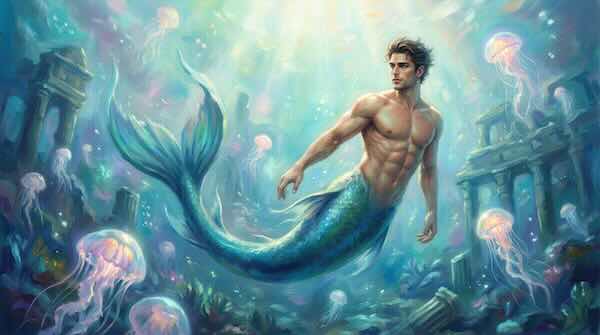
Try this. Search “mermaid books” and you will drown in results. Lists, subgenres, entire BookTok shelves, gorgeous covers with iridescent tails and hair fanning out like seaweed. Now search “merman books.”
Go ahead. I’ll wait.
You get a handful of real results, a lot of the same mermaid lists you just saw, and about forty romance novels where a merman shows up in chapter nine to be handsome and mysterious and then hand the plot back to the human girl.
This has bothered me for years, and not only because I wrote one. It bothers me because the folklore is full of mermen. They are everywhere in the old stories. They were the first ones, actually. And then somewhere between a Danish fairy tale and a Disney musical number, they mostly vanished from fiction, leaving behind a genre where half the species doesn’t get a point of view.
So let’s go find ’em. Below you’ll find the history of how mermen got written out, plus fifteen or so books where the merman is an actual character with an actual interior life. Some are YA, some are very much not, and I’ll flag which is which so nobody gets ambushed.
The mermen came first
Here’s the thing that often surprises people: the oldest merfolk figure in recorded myth is a dude.
Oannes, sometimes identified with the Babylonian god Ea, was a fish-bodied being who came out of the Persian Gulf to teach humans writing, agriculture, and law. That’s roughly 5,000 years of merman before Ariel. He wasn’t seductive or tragic. He was a teacher. He showed up, handed civilization to a bunch of confused humans, and went back underwater at sunset.
The Greeks had Triton, son of Poseidon, who calmed the seas by blowing on a conch shell, and eventually a whole plural category of “tritons” who were basically merman infantry. Slavic folklore has the vodyanoy, an unpleasant old frog-man who drowns people who swim at the wrong hour. Scottish sailors worried about the Blue Men of the Minch, blue-skinned sea creatures who would surface next to your ship and challenge the captain to a rhyming contest. If you lost, they capsized you. I love them. I think about them constantly.
And then there’s the Irish merrow, which is my favorite piece of evidence for what went wrong. In the old accounts, female merrows are beautiful. Male merrows are described as having green hair, green teeth, pig’s eyes, and a red nose, and they wear a little red cap that lets them travel between the sea and the shore.
Green teeth. A red nose. That is not a love interest. That is a guy at the end of the bar at closing time.
(I went deeper on the global folklore in this post on mermaid mythology around the world if you want the full tour. It’s one of my favorites.)
So the raw material was always there. Mermen just got assigned the ugly, the monstrous, and the bureaucratic, while mermaids got assigned longing, beauty, and sacrifice. Guess which one the nineteenth century decided to build a genre on.
Blame Hans Christian Andersen. (Partly).
Andersen published “The Little Mermaid” in 1837, and it did something enormous: it made merfolk fiction about interiority. About wanting a life you weren’t born into badly enough to give up your voice for it. That’s a permanent story. It’s why we’re all still here.
But it also locked in a template. The merfolk protagonist is female, she is in love with a human, she trades something essential for legs, and the ocean is the thing she has to leave. A hundred and eighty years of imitation later, that template is so dominant that “mermaid book” is a genre and “merman book” is a search term with almost nothing behind it.
Curiously, mermen did just fine in one place: comics. Namor the Sub-Mariner showed up in 1939, two years before Aquaman, and both of them have been continuously in print for eighty-plus years. So it isn’t that readers reject men with tails. It’s that we only let them be kings and soldiers. The moment a story wants tenderness or longing or transformation out of a merfolk character, publishing has historically reached for a girl.
The books below are the ones that didn’t.
YA merman books where the merman is the point
The Vicious Deep by Zoraida Córdova. If you read one book off this list, make it this one. Tristan Hart is a Coney Island lifeguard who gets swept out to sea by a freak storm, washes back up three days later with no memory and no visible injuries, and slowly works out that he is not only a merman but a contender for a vacant sea throne. It’s funny, it’s fast, it’s a teenage boy trying to be normal while his legs keep turning into a tail at inconvenient moments. The rare merman book where the merman is the narrator, the hero, and the one making the choices.
Of Poseidon by Anna Banks. Galen is a Syrena prince sent to land to investigate a human girl who might not be human. This one is closer to a classic YA paranormal romance in shape, and Emma gets a lot of the page time, but Galen is a genuine co-lead with his own family politics and his own stakes, which was not a given in 2012. Light, banter-heavy, easy to hand to a fourteen-year-old.
Deep Blue by Jennifer Donnelly. The Waterfire Saga is an underwater epic fantasy with a full political system, six mermaid protagonists scattered across the world’s oceans, and a merman named Mahdi whose arranged-marriage plotline turns into something much more interesting than it first appears. Ensemble rather than solo, but if you want worldbuilding rather than romance, this is the deepest water on the YA list.
Forgive My Fins by Tera Lynn Childs. The lightest thing here by a mile. Mermaid princess, high school, a human boy she’s crushing on, and a neighbor she has accidentally bonded herself to. It’s fluffy and it knows it. Included because the merfolk-bonding mechanic is genuinely charming and because sometimes you want a book that isn’t going to hurt you.
Adult and literary merman books
Heads up: everything in this section is grown-up. Some of it is grim.
The Merman by Carl-Johan Vallgren. A Swedish literary novel about a girl named Nella scraping by in a coastal town, dealing with a bullied brother, absent parents, and debts to the kids tormenting him. Then she discovers what her friend’s brothers are keeping in the boathouse. This is not a romance and there is nothing beautiful about the creature. It’s a book about cruelty, and how a caged thing that cannot speak becomes a mirror for everyone who looks at it. Bleak, gorgeous, and it stays with you.
The Shape of Water by Guillermo del Toro and Daniel Kraus. Yes, the movie. But the novel was developed alongside the film rather than adapted from it, and it goes places the screen version couldn’t, particularly inside the head of a mute cleaning woman falling in love with an amphibian man in a Cold War research facility. The definitive modern argument that a merman story can be a love story without being a fairy tale.
Underneath by M.N. Arzu. An injured merman washes up on a beach in Maine and ends up in a medical facility where nobody knows what to do with him, while a reporter chases the story and a hidden merfolk society argues about whether to sacrifice him or finally tell humanity the truth. More thriller than romance, and one of the few books that treats “what if merfolk had to deal with hospitals, journalists, and the military” as a serious question.
The Pisces by Melissa Broder. A woman falls apart in Venice Beach and then falls in love with a merman she meets on the rocks at night. It is explicit, extremely funny, and genuinely upsetting about addiction and desire. Absolutely not YA. I’m putting it here because it’s the only book I know that takes the siren dynamic and asks what it would actually feel like to be the one on the shore, and the answer is not romantic.
Queer merman romance, which is where the subgenre is actually alive
Here’s the plot twist to this whole post. When I went looking for books where mermen are the emotional center rather than the scenery, I kept landing in the same place: MM romance and queer speculative fiction. Not the mainstream YA shelf. That corner of publishing has been quietly writing merman leads for a decade while everyone else was doing sirens.
Stealing the Wind by Shira Anthony. Book one of the Mermen of Ea trilogy, and the title that sits at the top of most queer merfolk lists for good reason. A ship’s captain, a merman, a prophecy, and a real fantasy plot underneath the romance.
Blood in the Water by Megan Derr. Merfolk politics and a murder investigation, from an author with a long track record in queer fantasy romance. Denser worldbuilding than the average romance in this space.
The Guppy Prince by C.W. Gray. First in the Silver Isles series. A merman prince who is too chubby, too loud, and too unrefined for his own court, which is a much warmer and funnier premise than most of what’s on this shelf. Followed by The Not So Little Merman.
Escaping the Merman by Aramis Jordan. A sailor and a merman, gay-for-you, and a colony of mermen who are explicitly dangerous rather than decorative. Steamy and it says so on the tin, so calibrate accordingly.
Heat levels across this section run from mild to extremely not-mild, and the covers are not always a reliable guide, so check before you hand any of these to a teenager.
What a merman story can do that a mermaid story can’t
The Andersen template is a story about voice and sacrifice. She wants a world she wasn’t born into, and the price is the thing that makes her herself. It’s a story about giving something up to be loved.
But merfolk myth has a second story in it that we almost never tell, and it belongs to the mermen: a story about inheritance and refusal. Oannes had a job. Triton had a father. The merrow had a red cap he needed in order to cross between worlds and a whole community that expected him to keep wearing it. That’s not a story about giving up your voice for love. That’s a story about being handed a role by the sea, by your family, by an entire civilization that’s been running the same way for a thousand years, and deciding you will not take it.
That story has a different engine. It runs on duty instead of longing, and it ends with leaving instead of arriving. And I think we’ve barely written it.
Which brings me to my own merman
Merman Rises is the book I wrote because I wanted to read that second story and couldn’t find enough of it. Meet Delphin.
Delphin is the son of Jahvo, the regent of a walled merrow colony, which means his life is a schedule of rules he did not agree to and a throne he does not want. Life under the sea is easy when you know the rules, and Delphin knows every one of them. The book opens with him being made to watch an execution, which tells you approximately everything about the kind of inheritance he’s been offered.
Then he goes on his first Hunt into the open ocean, breaks the surface for the first time, and saves the life of a human boy named Elias, who is sixteen and starving and trying to get his family out of a country coming apart around them.
What follows is Delphin rejecting every rule he was raised on, leaving the colony, and going up into the perilous world of humans to find that boy again. His sister Ariella has her own catastrophe running in parallel and gets her own chapters. There’s an old sheath with a curved blade missing from it that connects two worlds neither character knew were connected.
It sits in the same universe as The Mermaid Curse series but you can read it cold. No homework required.
Start in the shallow end, free
If any of this sounds like your water, the easiest way in is Alabaster Island, the prequel novella to the Mermaid Curse world. It’s free, it’s short, and it will tell you within about twenty pages whether my particular flavor of dark ocean fantasy works for you. Grab it by joining the VIP Book Club and I’ll send it straight to your reader.
If you’d rather go directly to the mermen, Merman Rises is here.
And if dark mermaid fiction is more your speed, I put together six mermaid books that aren’t The Little Mermaid a while back, which is the sister post to this one.
Happy reading, MSK
Now tell me what I missed. There are merman books buried in this genre that never surface on any list, and I know some of you have them. Drop your best one in the comments and I will absolutely go buy it.
Recent Comments