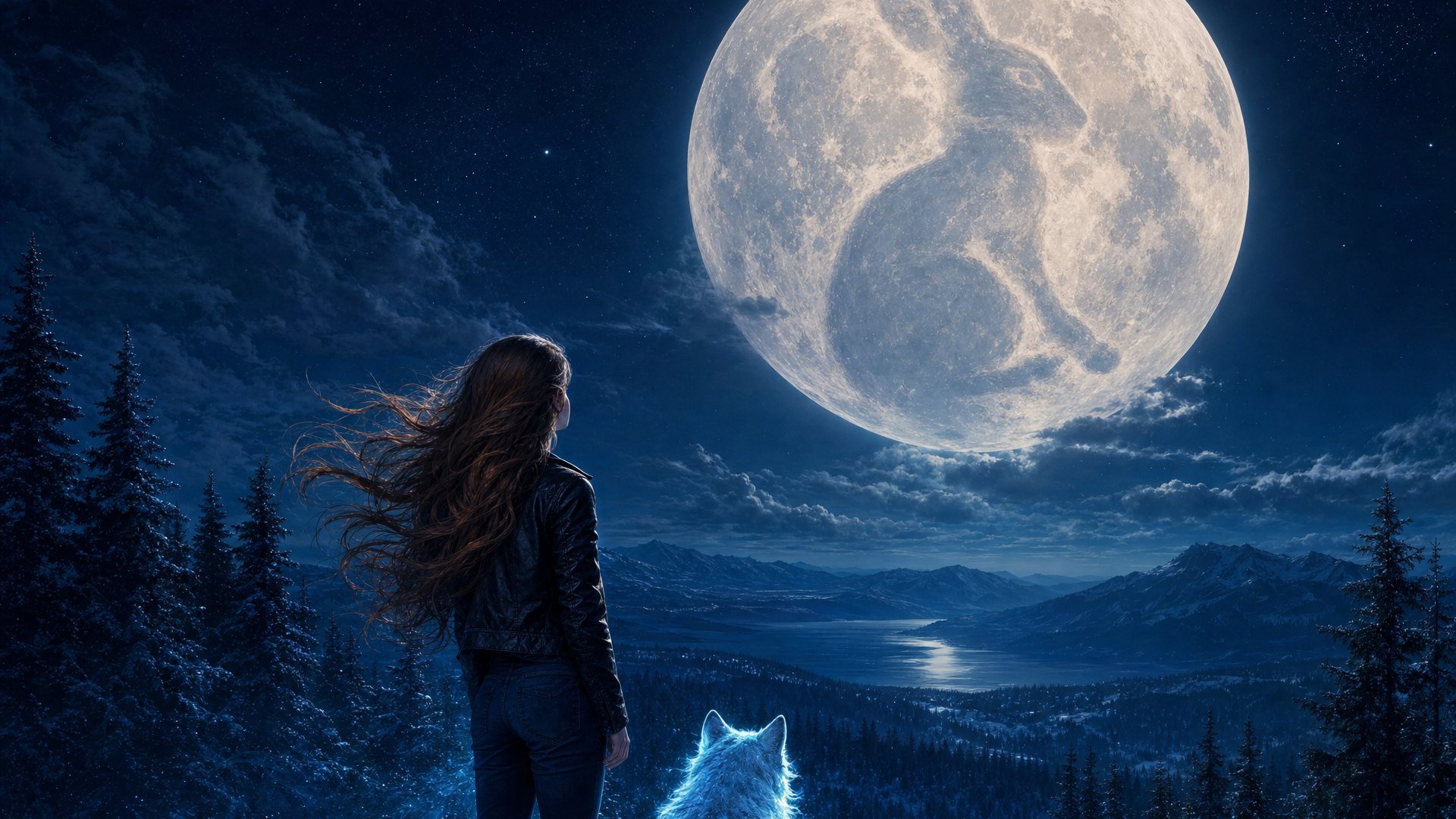
On Tuesday, November 24, the full Beaver Moon rises (yes it's a thing), and NASA counts this one as a supermoon. That makes this the perfect week for moon myths! Every culture that ever looked up at the night sky told a story about that big pale face in the sky. A surprising number of them involve rabbits, wolves and people who went up there and never came back down.
I've written about the werewolf side of the moon before. But time I wanted to look at the rest of the legends. Here are EIGHT moon myths from around the world...plus a little on how the moon picked up its reputation for making people (and wolves) a bit wild.
Moon myth 1: the rabbit in the moon (China and Japan)
In the West we tend to see a face in the full moon. But across much of East Asia, people see a rabbit. In Chinese tradition it's the Jade Rabbit, who lives on the moon with the goddess Chang'e and pounds the elixir of immortality with a mortar and pestle. China even named its lunar rovers after it: Yutu, the Jade Rabbit.
In Japan, the rabbit is still at the mortar, but it's pounding rice to make mochi. Which, TBH, is a cozier job than brewing immortality.
One of the oldest versions comes from a Buddhist Jataka tale. A hare has nothing to offer a hungry traveler, so it throws itself into the fire to become his meal. How selfless! The traveler turns out to be a god, Sakra, who pulls the hare from the flames unharmed and draws its picture on the moon so everyone will remember what it did.
Moon myth 2: the rabbit the gods threw (Aztec)
The Aztecs saw a rabbit too, and theirs also got there the hard way. After the last world ended, the gods gathered in the dark to make a new sun, and someone had to leap into a sacred fire to become it. The humble god Nanahuatzin jumped first. The proud Tecciztecatl hesitated, then followed.
Now there were two suns, just as bright. So one of the gods threw a rabbit at Tecciztecatl's face, dimming him into the moon. That's the rabbit you can still see there. Versions disagree on why...either to punish his pride or because two suns would scorch the earth, but they agree on the rabbit.
Moon myth 3: the wolf chasing the moon (Norse)
And of course there's a wolf. In Norse mythology, the moon is Máni, brother of the sun, Sól, and he drives the moon across the sky. He has a good reason to keep moving: a wolf named Hati Hróðvitnisson chases him every night. The Prose Edda says that at Ragnarök, the end of the world, the moon will finally be swallowed.
And here's a strange bit of trivia. The same book says Máni once snatched two children, Hjúki and Bil, as they carried a bucket of water on a pole from a well. They've followed him ever since. Some scholars compare them to Jack and Jill, who also went for a pail of water.
Moon myth 4: the man in the moon (Europe)
The face English speakers see is usually the good ole Man in the Moon, but in older European folklore he wasn't a jolly round face. He was a man sent up there as punishment, often for gathering sticks on the Sabbath, a story tied to a passage in the Book of Numbers. That's why old pictures show him carrying a bundle of sticks on his back.
Shakespeare knew about the tradition. In A Midsummer Night's Dream, the actor playing Moonshine comes on stage with a lantern, a thornbush and a dog: the man in the moon, his sticks and his dog, exactly as the audience would have pictured him.
Moon myth 5: the moon goddess and the sleeping shepherd (Greece)
Selene, the Greek goddess of the moon, drove her silver chariot across the night sky and fell for a mortal named Endymion. In the best-known version, Endymion was granted eternal sleep, forever young, and Selene visited him every night.
It's a gorgeous image and a slightly unsettling romance. He never wakes up. She never stops coming. The moon keeps its own hours.
Moon myth 6: the woman who moved to the moon (Hawaii)
In Hawaiian tradition, Hina is the goddess of the moon. The Hawaiian word for moon, mahina, is connected to her name. In one well-known telling, she escapes a hard life on earth by going up to the moon, carrying her calabash with her most treasured things. She's lived there ever since, and some say you can still make out her shape, calabash and all, on a clear night.
I love that she didn't need rescuing. She packed a bag and left.
Moon myth 7: the moon that makes you mad
This one shows up in the dictionary. "Lunatic" comes from the Latin luna, moon, because for centuries people believed the moon could unsettle the mind, and that madness got worse at the full moon. Romans believed it. Medieval doctors believed it. Plenty of nurses and police officers today will swear that full-moon nights are busier, even though studies haven't backed that up.
That idea of the full moon pulling something wild out of a person is where werewolves come in. I dug into the history in werewolf mythology around the world, including how the full moon only became the werewolf rule fairly late in the story.
Finally moon myth 8: why it's called the Beaver Moon!
The full moon names you see every month, like the Beaver Moon, mostly come to us through the Old Farmer's Almanac, which draws on Native American, colonial American and European sources. The Almanac gives two reasons for November's name. It's the month beavers retreat into their lodges for winter, and it was traditionally the time to set beaver traps before the swamps froze, for warm winter furs.
Next month's full moon is the Cold Moon, and in January we get the Wolf Moon, which is the best name on the calendar.
What these moon myths have in common
Read enough moon myths and you see a pattern. The sun is often steady and public. The moon is where things go to change. A hare ends up drawn on the moon. A proud god becomes a dimmer light. Children get carried off mid-chore. A woman walks away from her life. The moon is the place for transformation, which is exactly why it ended up ruling over shapeshifters.
Where my books fit: Before the Moon
My Moon Shifter Academy series is about Kat Borisyuk, a teenager who is the last wolf shifter alive. She's been taking a pill called Diurnal her whole life to keep her wolf asleep. In my books, the moon matters, but it isn't the only thing that wakes the wolf. Kat's shift is tied to emotion and control as much as the lunar phase, and a lot of grief runs through her story too, in the loss that shaped her and the choices she makes because of it.
Before the Moon is the prequel. It tells the story of how Kat ended up in New York in the first place, and the boy who brought her there. Her hometown is a lot like the small upstate town where I write. Hmmm, I wonder why. It's free, so if you want a moonlit read for the supermoon, you can grab Before the Moon here. And if you're looking for more shifter stories after that, here's my list of YA werewolf books.
More myth deep dives from the blog
- How mermaid myths differ around the world.
- Selkie mythology, and why the seal-wife legends aren't romance.
- The magic of familiars, mystical animals in fiction through the ages.
So when you look at the full moon on Tuesday night, what do you see: a face, a rabbit or a wolf getting a little too close? Tell me in the comments. And if the sky's clear where you are, go look. It's the biggest moon we'll get for a while.
I'll be spending Thanksgiving with family in Lake Worth Beach, where I'll probably get talked into the Turkey Trot again, push way too hard and then eat an enormous meal with zero guilt.
Happy reading, and happy Thanksgiving week,
MSK