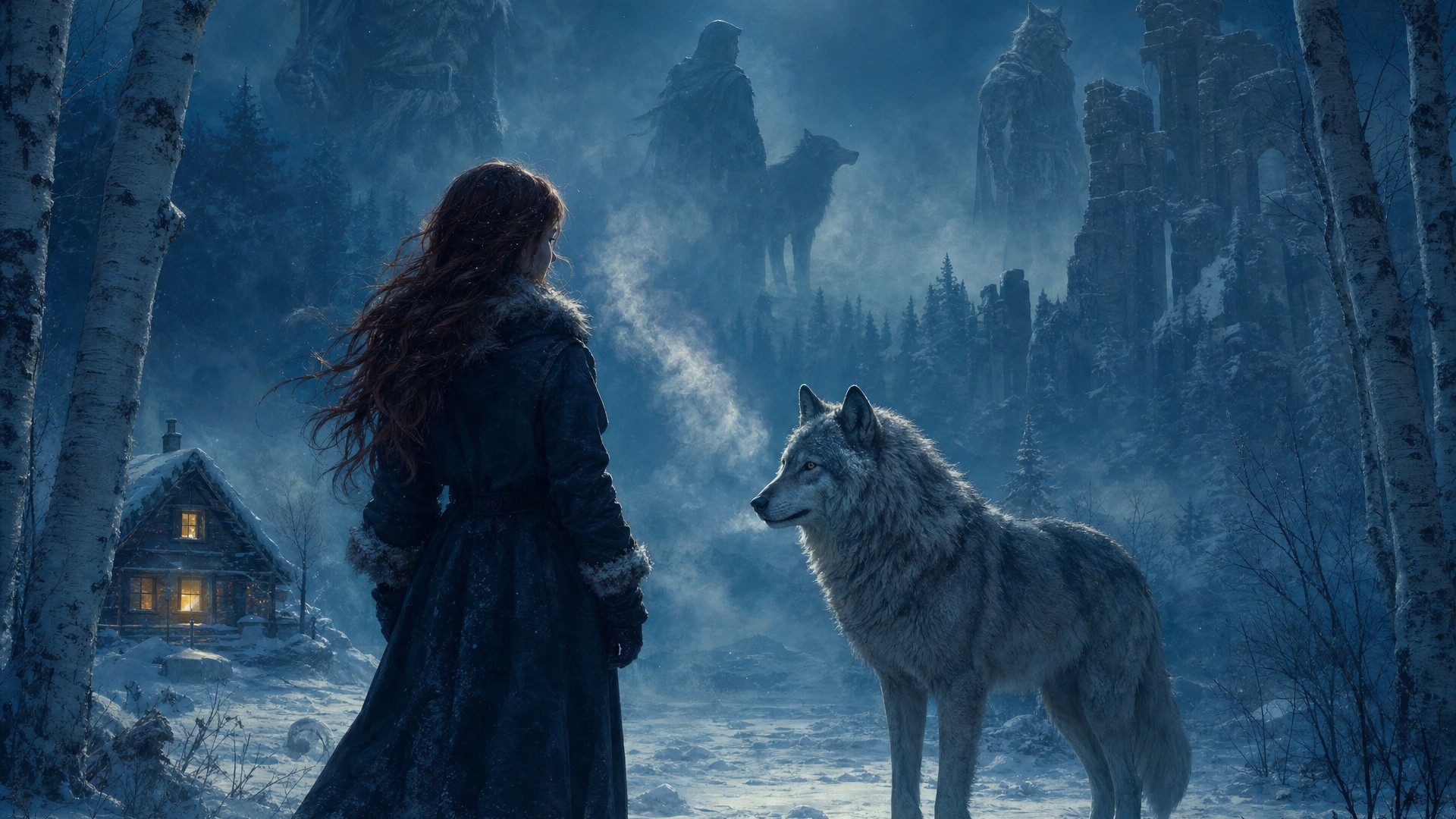
Say "werewolf" and most of us picture the same thing: a big ole full moon, a painful transformation, and maybe a silver bullet waiting in somebody's pocket. But werewolf mythology is much older, stranger and more varied than that. Long before Hollywood wrote the rulebook, cultures across Europe and the Americas told stories about people who became wolves. Sometimes as a curse, sometimes as a punishment from the gods, and sometimes on purpose.
I went down this rabbit hole (wolf hole?) the same way I did with mermaid mythology around the world, and the pattern is the same: the old legends are wilder than anything we've done with them since. Here's a tour of seven werewolf legends that shaped the shifters we read about today.
Werewolf mythology starts with a king who served the wrong dinner (Ancient Greece)
One of the oldest werewolf stories in Western literature belongs to Lycaon, a king of Arcadia. In the version Ovid tells in the Metamorphoses, Lycaon decides to test whether a visiting stranger is really Zeus by serving him human flesh. Zeus is not amused. He destroys Lycaon's house, and the king flees into the countryside, where his howls replace his words and his body turns into a wolf's.
That's where we get the word lycanthropy, and it sets up one of the oldest ideas in werewolf mythology: wolf as punishment. The transformation isn't random. It shows what was already inside the man.
The soldier by the tombs (Ancient Rome)
Rome gives us something that feels quite modern. In Petronius's Satyricon, a character named Niceros tells a campfire-style story about traveling at night with a soldier. By moonlight, among the tombs, the soldier strips off his clothes, circles them, and turns into a wolf. Later the wolf is wounded while attacking livestock, and the next day the soldier turns up with the same wound on his neck.
That "the injury follows you back into human form" detail shows up again and again in later werewolf folklore. Two thousand years later, it's still a handy way to reveal who the wolf really is.
Wolf-skins and warriors (Norse legend)
Norse sagas describe úlfheðnar, "wolf-skins": warriors associated with wolf pelts and a battle fury much like the better-known berserkers. And in the Völsunga saga, Sigmund and his son Sinfjötli find enchanted wolf skins, put them on, and get trapped in wolf form for a set number of days, hunting and fighting as wolves before they can take the skins off again.
Here the transformation is something you wear. It's power you choose to put on, but with a price attached. If you love shifters who have a complicated relationship with their wolf (raising my hand here), this is one of the roots of that idea.
The volkolak and the oboroten (Slavic folklore)
Slavic folklore has its own wolf-people, called volkolak (and similar names across Slavic languages) and, in Russian, oboroten, "one who turns." Depending on the region, a person might become a volkolak through a sorcerer's curse, through being born under unlucky signs, or through witchcraft of their own. In some traditions the line between werewolf and vampire gets blurry, which tells you how much these stories were really about fear of the uninvited thing at the edge of the village.
What I love about the Slavic tales is how often the wolf is tied to family and fate. It isn't only something that happens to you. Sometimes it's something you're born into. And given that my grandad was born in Slovakia, this one holds a special place!
The cursed pair of Ossory (Ireland)
Not every werewolf legend is a monster story. In the twelfth century, Gerald of Wales wrote about a priest traveling through Ossory who meets a wolf that speaks. The wolf explains that he and a woman are from Ossory, cursed to live as wolves for seven years before they can return to human life, and he begs the priest to give his dying companion the last rites.
It's a werewolf story built around compassion, faith and grief. These wolves are victims of a curse, not villains, and the story asks the priest (and us readers) to see the person inside the animal.
The loup-garou and the rougarou (France and Louisiana)
France had its loup-garou, and early modern France took the idea terrifyingly seriously: werewolf accusations actually reached the courts during the sixteenth and seventeenth centuries. The legend crossed the Atlantic with French settlers and changed shape in Louisiana, where Cajun and Creole folklore tells of the rougarou, a wolf-like creature said to haunt the bayous. In some tellings it hunts people who break the rules, like Catholics who don't keep Lent.
I love this one because you can watch a legend migrate. Same wolf, new swamp, new rules.
The lobizón and the seventh son (Argentina and Paraguay)
In the folklore of Argentina, Paraguay and southern Brazil, the lobizón is tied to birth order: the seventh son in a row is fated to transform. The legend is often linked to a real-life custom in Argentina, where the president can become the honorary godparent of a family's seventh son or daughter. Whether or not the two are really connected, it's a perfect example of how werewolf mythology keeps tangling itself into everyday life.
Wait, where did the full moon and silver bullets come from?
Mostly from the movies. Moonlight appears in old tales like the Roman one above, but the tidy modern rulebook (the bite that spreads the curse, the unavoidable full-moon change, the silver weakness) was cemented by twentieth-century film, especially Universal's The Wolf Man (1941) and its sequels. That's why so many modern authors feel free to break those rules. They were never ancient to begin with.
Real wolves are more interesting than the rulebook too. If you want to see how the "alpha" myth fell apart, I dug into that in Pack Dynamics IRL, and into how shifter hierarchies work on the page in Alpha, Beta, Chaos.
Modern werewolf books that play with the old legends
- Shiver by Maggie Stiefvater. In Mercy Falls, Minnesota, the wolves in the woods are human in the warm months and wolves when it gets cold. Grace has been watching one of them, Sam, her whole life. Quiet, wintry and heartbreaking.
- Moon Called by Patricia Briggs. Mercy Thompson is a Volkswagen mechanic who can shift into a coyote, living alongside werewolf packs with very strict politics. Great if you like urban fantasy with pack rules that actually matter.
- Wolfsong by TJ Klune. Ox finds a family of wolf shifters, the Bennetts, in the small town of Green Creek, and his life changes forever. It's found family and pack loyalty turned all the way up.
For more, my older roundup of YA shifter books is still a good place to dig.
Where my books fit
In Before the Moon, the prequel to my Moonshifter Academy series, Kat is about to turn sixteen in a frozen little town. Her family is Russian, her brother Errol is gone, and sixteen was supposed to be the year she finally went to Moon Shifter Academy. Instead, every morning starts with a Diurnal, a pill that keeps her wolf asleep.
Like a lot of the old legends, Kat's story is about what a family passes down, and who gets to decide whether the wolf stays locked away. If that sounds like your kind of werewolf story, Before the Moon is free when you join my reader list.
Which werewolf legend would you most want to see in a novel: the talking wolves of Ossory, the Norse wolf-skins, or the bayou rougarou? Tell me in the comments.
Happy reading, MSK