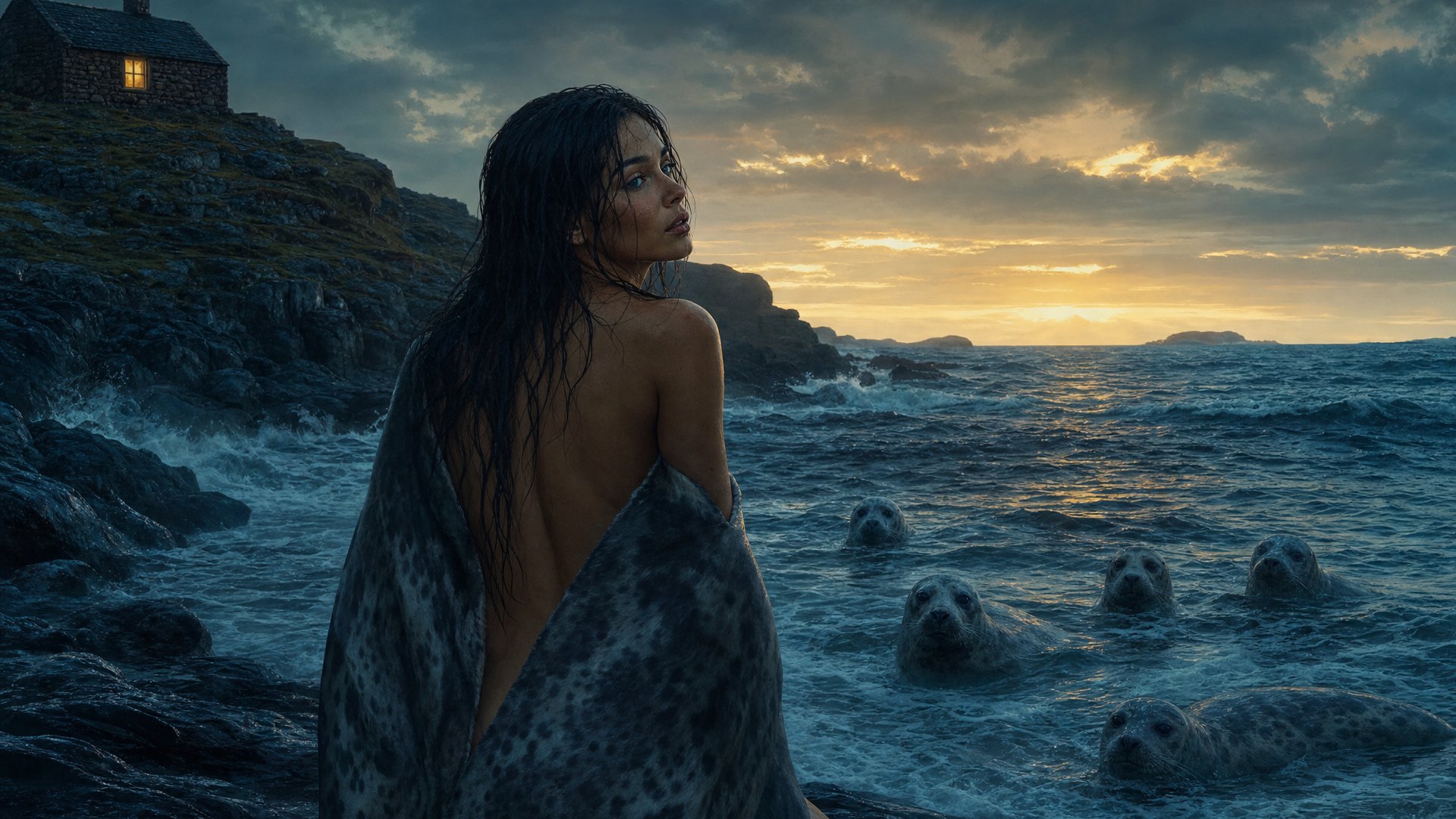
Selkie stories are often marketed as romantic tales. You have a lonely fisherman, a captivating woman from the sea…and a love that transcends the boundaries of time. But delve into the original versions of these stories and you find a different and complex narrative. Selkie myths are steeped in themes of stolen skins, hidden secrets, abandoned children, and a legendary curse that is far from being resolved.
As a writer of dark mermaid fantasy, and a total sucker for islands, I couldn’t resist exploring the origins of these tales. Let me share with you the true essence of the seal-folk legends from Orkney, Shetland, Ireland, and the Faroe Islands, and why I believe they hold a such profound and melancholic place in the annals of sea lore.
What is a selkie?
A selkie is a seal that possesses the extraordinary ability to shed its skin and transform into a human being. The term “selkie” originates from the ancient Scots word for a seal, “selch.” These stories predominantly emerge in the northern islands, including Orkney and Shetland off the coast of Scotland, the Faroe Islands, Iceland, and the west coast of Ireland. These particular islands are often associated with seals that haul out on rocky shores, their watery gaze conveying a sense of wisdom and knowledge.
The rules governing selkie mythology are simple, which adds to their inherent cruelty. In human form, a selkie is bound to return to the sea without its skin. The person who possesses the skin holds the selkie captive.
Note that Orkney folklore encompasses a diverse range of sea creatures, and while selkies are not synonymous with the Finfolk, they share similarities. The Finfolk are darker sorcerers who abduct individuals and transport them to hidden islands. But selkies, on the other hand, are often the victims of these abductions.
The stolen skin: the classic selkie wife legend
This is the version of the selkie story that resonates most with people, and it appears in various forms across the northern islands, with minor variations.
Imagine a man strolling along the shore at night, delighted by the sight of seal people dancing on the sand, skins neatly piled on the rocks. Intrigued, he grabs a skin and conceals it. As the other skins slip back into the sea, a woman remains behind, eyes filled with a sense of longing. Compelled by compassion, love at first sight and/or perhaps a wee bit of lustiness, the man takes her home, and they start a life together. They have children, and by every measure, their life appears to be filled with happiness and fulfillment.
But she keeps gazing at the water. One day, one of her kids (usually the youngest) mentions the strange skin concealed in the rafters, beneath a stack of hay, or within a locked chest. She takes it, kisses the children, and escapes to the sea. In other versions, she is later seen, a seal observing the house from the waves. In some, she brings fish to the shore for her children (yay, fresh seafood!) But never returns to her husband.
Okay, read it again with fresh eyes…it’s not a love story. It’s a woman trapped on land by a man who stole the one thing she needed to escape. The “happy marriage” lasts just as long as the lie. That’s why I find it captivating it as folklore. It’s honest about something fairy tales often gloss over.
The Seal Woman’s Curse: Kópakonan of the Faroe Islands
The Faroese version begins the same but takes a darker turn. On the island of Kalsoy, a young farmer from the village of Mikladalur steals a seal woman’s skin and keeps her as his wife. Years later, she finds it and returns to the sea, to her seal husband and children she had left behind.
Then, the men of the village plan a seal hunt in a sea cave. The seal woman appears to the farmer in a dream and warns him to spare her family. He disregards her warning. Consequently, her seal husband and sons are killed.
Her revenge is one of the coldest curses in folklore: men from Mikladalur will drown at sea or fall from the cliffs until there are enough of them to link hands all the way around the island of Kalsoy. The story was documented by the Faroese priest and folklorist V. U. Hammershaimb in 1891. People who recount it often add that the chain isn’t yet complete…
Since 2014, a bronze and steel statue of Kópakonan by sculptor Hans Pauli Olsen has stood in Mikladalur’s harbor, partially out of her skin, gazing back at the village.
Selkie Men and Seven Tears
But it’s not only seal women who feature in these stories. In Orkney and Shetland lore, male selkies also come ashore and are the seducers of the story. They are drawn to lonely or unhappy women, often wives whose husbands are away at sea.
One Orkney detail lingers in my mind. A woman seeking to summon a selkie man could visit the shore during high tide and shed seven tears into the sea. The most famous version recounts Ursilla, a woman from the island of Stronsay, who was rumored to perform this ritual. Seven tears, not a spell or a song, but pure grief, offered to the water.
Selkie men are one of the few places where sea-folk legends give the men a story of their own. Mermen really get the short shrift. That's a big part of why I wrote Merman Rising: they need their stories told too.
However, for the bleakest portrayal of selkie mythology, delve into this ancient ballad. A Shetland version was collected in 1852 from an elderly woman of Snarra Voe and later became Child Ballad 113. Folk singers continue to perform it.
A woman nursing a baby contemplates aloud about the father’s identity. A stranger appears and reveals that he is, and he is a man on land and a selkie in the sea. He give her a purse of gold, takes their son, and makes a chilling prophecy. She will marry a gunner, and that gunner will shoot both the selkie and the boy. In the more elaborate Orkney versions, this prophecy comes true.
There is no rescue, no unexpected twist. The mother is told precisely how she will lose her child, and then she loses him. Bang. Nope, songs are not to be taken lightly.
The families who claim to be descended from seals
Here, folklore intertwines with family history. On North Uist in the Outer Hebrides, the MacCodrums were known in Gaelic as the MacCodrums of the seals. The legend tells of an ancestor who married a seal woman. In Ireland, the Conneely (Ó Conghaile) family of Connemara has a similar tradition, and it was believed to be extremely unlucky for a Conneely to kill a seal.
Of course, none of this is documented history in the strict sense. But, I find it fascinating that people claimed such stories and who knows? Imagine growing up hearing that your great-great-grandmother walked out of the sea and eventually returned.
Selkies vs mermaids: what's the difference?
- The body: a mermaid is half human and half fish all the time. A selkie is fully seal or fully human, and the skin is the switch.
- The danger: mermaids and sirens are usually the threat, luring sailors to drown. Selkies are usually the ones in danger, from hunters and from men who steal their skins.
- The ending: mermaid stories often end with someone dragged into the sea. Selkie stories end with someone going home to it.
If you want the full sea-creature lineup, I compared the two biggest ones in siren vs mermaid, and I went around the globe in how mermaid myths differ around the world.
Selkie stories to watch and read
- Song of the Sea (2014): the gorgeous animated film from Cartoon Saloon and director Tomm Moore. Ben and his little sister Saoirse, who turns out to be a selkie. Bring tissues. It's about a missing mother, after all.
- The Secret of Roan Inish (1994): John Sayles's quiet film about a girl named Fiona and her family, the Coneellys, who are said to have a selkie in the family tree. It's based on Rosalie K. Fry's novel The Secret of the Ron Mor Skerry.
- Sealskin by Su Bristow: an adult novel that retells the classic stolen-skin legend from the inside, and doesn't look away from what the theft really means.
Where my book Alabaster Island fits
There are no selkies in Alabaster Island. But it grew out of the same mysterious water. Seventeen-year-old Marei lives on a remote island home to twenty-one families, where nobody under eighteen has ever left for the mainland. Then she meets a mermaid, a creature everyone thought was extinct, and the mermaid tells her to leave. That's a girl trapped on land, too. And the mermaid has her own agenda.
The book opens with Marei, years later, whispering her story into a magic seashell for the twin daughters she had to leave behind. If the selkie mother walking into the waves breaks your heart a little, that one might too. It's the prequel to The Mermaid Curse series, which tells the secret origin of mermaids across generations of women in one family, and it's free: you can grab Alabaster Island here.
More dark ocean reading from the blog
- Mermaid books that aren't The Little Mermaid, a reader's guide to dark ocean fantasy.
- Merman books, and the question of where all the male mermaids went.
- Dark mermaids in YA paranormal fiction.
So here's my question for you...one that won't leave me alone: if you were the youngest kid in that cottage, and you knew where the skin was hidden, would you have told her? Tell me in the comments.
Happy reading,
MSK