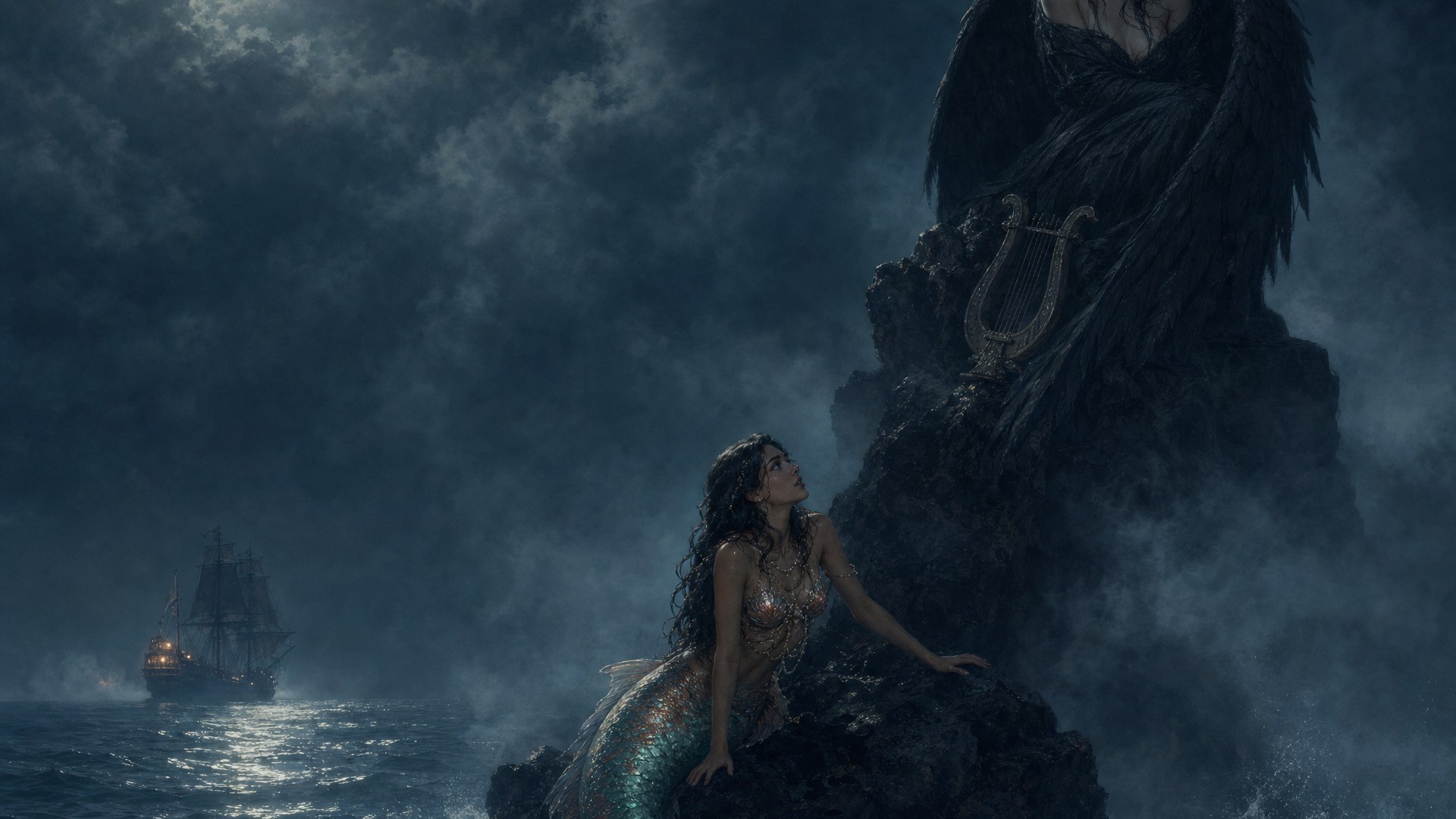
Every October I get a version of the same question: "Aren't sirens just evil mermaids?" It's a fair guess. Movies, games and half the book covers on Pinterest treat the two as the same creature with different lipstick. But the siren vs mermaid question has a surprisingly good answer, and it involves feathers. Lots of feathers.
So grab something warm to drink. Here's where sirens came from, how they ended up with fish tails, and why the difference still matters when you're picking your next spooky-season read.
Siren vs mermaid: the short answer
In the oldest stories, sirens and mermaids aren't related at all.
- Sirens come from Greek myth. They were part woman, part bird, they lived on a rocky island, and their weapon was a song that lured sailors to their deaths.
- Mermaids come from a much wider web of sea folklore, from the Near East to Ireland. They're half human, half fish, and depending on who's telling the story they can be lovers, tricksters, omens of storms or royalty under the waves.
Put simply: a siren is defined by what she does (sing, lure, destroy). A mermaid is defined by what she is (half fish). Over a couple thousand years, those two ideas swam into each other and never quite untangled.
What did sirens look like in Greek mythology?
Our most famous siren scene is in Homer's Odyssey. The sorceress Circe warns Odysseus about the Sirens, who sit in a meadow surrounded by the bones of men who stopped to listen. Odysseus does the sensible thing and the unsensible thing at the same time: he plugs his crew's ears with beeswax, then has himself tied to the mast so he can hear the song and survive it.
Here's the part I love. The Sirens don't promise him romance. They promise him knowledge. They claim to know everything that happened at Troy and everything that happens on earth. That's a much creepier pitch. They aren't selling a pretty face. They're selling the one thing a clever, curious man can't resist.
Homer doesn't spend much time on their looks, but Greek artists filled in the gaps. On vases and tomb carvings, sirens are birds with women's heads, sometimes with arms holding a lyre. Not seductive. Unsettling, in the way an owl staring at you from a fence post is unsettling.
Later Greek and Roman writers added backstory. In Ovid's version, the sirens were companions of Persephone who were given wings so they could search for her after she was taken to the underworld. In the Argonautica, Orpheus gets the Argonauts past the sirens by playing his lyre louder and better, which is the most musician solution to a monster problem ever invented. (I wrote more about this kind of thing in my post on what magic sounds like.)
So when did sirens become mermaids?
Slowly, and mostly in the Middle Ages. By around the 8th century, a book of monsters called the Liber Monstrorum was describing sirens as sea-maidens with the tails of fish. Medieval bestiaries kept going in that direction, and artists started giving sirens scales instead of feathers, or sometimes both, which is a look I'd pay to see on a book cover.
Why the switch? A few likely reasons:
- Geography. Sirens lived by the sea and drowned sailors. A creature that lives in the sea is a short creative leap away.
- Church symbolism. Medieval writers used the siren as a symbol of temptation, and a beautiful woman with a fishy secret fit that sermon nicely.
- Language. Once the words blurred, the creatures did too. To this day, the word for mermaid in Spanish and Italian is sirena, and in French it's sirène.
So if you've ever been "corrected" for calling a mermaid a siren, you can shrug and tell them half of Europe agrees with you. 🙂
Where mermaids came from (it isn't Greece)
Mermaids have their own family tree, and it's a big one. One of the earliest fish-tailed figures is Atargatis, an ancient Syrian goddess often shown with the lower body of a fish. In medieval France there's Melusine, a woman who turns serpent or fish from the waist down once a week and makes her husband promise never to look. In Ireland there's the merrow, who needs a little red cap to travel between the sea and the land. Scottish and Irish coasts gave us selkies, who are seals that shed their skins to walk as people.
I went deep on these in how mermaid myths differ around the world, so I won't repeat the whole tour. The key point for today: most mermaid legends are about crossing between two worlds. Love, homesickness, a bargain, a promise that gets broken. Sirens almost never cross. They stay on their rock and wait for you to come to them.
Siren vs mermaid at a glance
- Body: Greek sirens were bird and woman. Mermaids are fish and human.
- Home: Sirens sat on rocks and islands. Mermaids live in the water.
- Power: A siren's power is her voice. A mermaid's power varies: shapeshifting, wishes, prophecy, sometimes just being very, very hard to catch.
- Motive: Sirens want you to stop and never leave. Mermaids usually want something more personal, like a soul, a sweetheart, or to go home.
- Vibe: Sirens are horror's cousins. Mermaids swing between fairy tale and tragedy.
Why the difference matters in fantasy books
Here's where I put on my writer hat. When an author calls a character a siren instead of a mermaid, it usually signals something about the story. A siren book tends to be darker. It's about desire, danger and the cost of listening. The love interest might be the thing that wants to drown you. A mermaid book has more room for wonder: hidden kingdoms, secret heritage, a girl who finds out the ocean has been calling her name all along.
The best books borrow from both. Hans Christian Andersen did it in 1837 with The Little Mermaid, which flips the siren myth inside out: instead of a sea creature who weaponizes her voice, he gives us one who trades her voice away. That's a big part of why that story still stings. (If you want mermaid books that skip the seashell bra and lean into the sting, here's my reader's guide to dark ocean fantasy.)
Siren stories are also perfect for October. Think about it: a voice in the dark, a promise you know you shouldn't trust, and sailors who can't look away. That's basically a ghost story with better acoustics. If you're curious how old myths like this got folded into the season, I dug into that in the haunting origins of Halloween.
Where my books fit: a mermaid who can't sing
I'll confess this topic is personal. When I wrote The Atlantis Song, book two of my Mermaid Curse series, I wanted to poke at the siren myth from a strange angle. What if the girl everyone expects to have the magic voice can't carry a tune?
Allie is a girl from a Hawaiian suburb who is very much not okay with being a mermaid, thank you. Then a pop star named Justice shows her an ancient scroll her missing mother left behind, a song that might change worlds, and asks her to sing it at a massive solstice concert on the canals of Adria. One small problem: she can't sing. At all. And somewhere in that music is an impossible note that might be the only way to save her sister.
So it's a siren story where the "siren" is terrified of the microphone, with a charming pop star, a sinister undertow, and a lot of salt water. It works best if you start with book one, The Atlantis Twins, and the whole series is in Kindle Unlimited if you're a KU reader.
And if you'd like to try my writing before committing to a whole sea voyage, you can grab a free book here. Also, for the merfolk fans who keep asking where the boys are, I made a list of merman books.
Your turn
Team siren or team mermaid? And the question I really want answered: if you were Odysseus, would you plug your ears, or would you be the one tied to the mast because you just had to hear it? (I already know my answer. I'd be on the mast, taking notes.) Tell me in the comments.
Happy reading, MSK